
GRP Grating for Telecom Towers & FRP RF-transparent Platforms
GRP grating and FRP grating are the decking of choice on cellular towers, microwave masts and rooftop antenna farms. Because fiberglass is non-conductive and RF-transparent, walkways and equipment platforms sit in front of antennas without reflecting or distorting the signal. ZeAllgrate supplies lightweight, corrosion-resistant GRP grating for top-of-tower access. See also our telecom industry page.
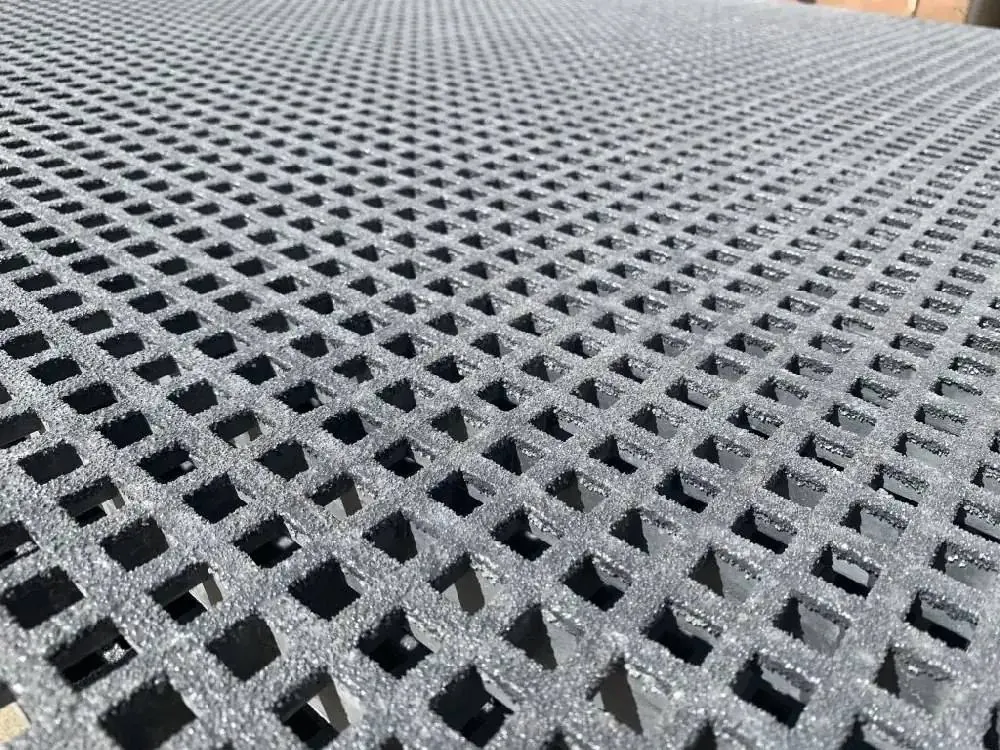
Walkways That Do Not Interfere With the Signal
Metal walkways and platform decks near antennas act as parasitic reflectors: they distort the radiation pattern, create standing waves and shift the electrical downtilt of the sector. GRP grating is dielectric — radio waves pass through it as if it were air. Installing an FRP grating walkway in front of or below the antenna changes the VSWR by less than the measurement tolerance, which is why telecom carriers worldwide specify fiberglass decks on every platform where a steel grate would have sat 20 years ago.
The weight saving is equally decisive. At 14 kg/m², GRP grating is one-quarter the weight of steel. On a 60 m lattice tower, every kilogram at the top drives wind load and foundation cost. Lighter FRP grating decks mean the existing tower can often carry extra antennas (5G adds mass) without structural reinforcement — a direct capex saving. Panels are carried up the tower by hand and bolted on with SS316 clips, no crane on site.
- RF-transparent — no VSWR shift, no pattern distortion
- Non-conductive — no lightning-induced ground loops
- Lightweight — reduces tower wind and dead load
- Salt & UV resistant — coastal and rooftop installations
Telecom-Grade GRP Grating Selection
UV-stabilized isophthalic GRP grating is standard for outdoor platforms; vinylester for coastal or chemical-exposed sites. Mini-mesh (19 × 19 mm) is preferred for rooftop decks where tools could fall through.
| Location | Resin | Mesh / panel | Max span |
|---|---|---|---|
| Tower platform deck | Isophthalic UV | #38 molded, 38 mm mesh | 900 mm |
| Rooftop equipment deck | Isophthalic UV | #38 mini-mesh 19 mm | 900 mm |
| Coastal / salt spray | Vinylester | #38 molded | 900 mm |
| Heavy tool / cabinet load | Vinylester | I 50×10 pultruded | 1200 mm |
All outdoor GRP grating carries a UV-stabilized surface veil; expect >70% flexural strength retention after 5000 h QUV exposure.
Where FRP Grating Serves Telecom Networks
Tower platform decks
RF-transparent walking surface around sectors.
Rooftop antenna walkways
Lightweight FRP grating on building roofs.
Equipment mounting pads
Non-conductive bases for RRHs and cabinets.
Microwave shelter floors
Corrosion-resistant equipment decking.
Cable ladder walkovers
GRP grating treads over fiber runs.
5G small-cell poles
Compact maintenance platforms at height.
RF Transparency and Lightning Safety
Dielectric materials have a relative permittivity (εr) around 3.5–4.5 for polyester GRP, far below metals. At microwave and sub-6 GHz frequencies the reflection coefficient of a GRP grating deck is negligible, and the open mesh (65% open area) lets the remaining energy pass unimpeded. Carriers routinely run VSWR sweeps before and after installing FRP grating platforms and see no measurable shift — the proof that the deck is electrically invisible to the antenna.
Lightning safety works in the same direction. Because GRP grating is non-conductive, it does not create a horizontal conducting path that could pull a strike sideways into the tower or induce currents in cabling. All metalwork remains bonded to the tower's down-conductor system, and the fiberglass deck simply does not participate. Combined with its UV and salt resistance, FRP grating is the only deck material that satisfies both the RF engineer and the structural engineer.
| Property | Steel platform deck | GRP / FRP grating deck |
|---|---|---|
| RF behavior | Reflects, distorts pattern | Transparent, no VSWR shift |
| Weight (38 mm) | ~45 kg/m² | ~14 kg/m² |
| Coastal corrosion | Rust in 3–5 yr | 25 yr, vinylester |
| Top-of-tower install | Crane required | Hand-carried by crew |
Telecom GRP Grating FAQ
Does GRP grating really not affect the antenna signal?
Yes. Fiberglass is dielectric and RF-transparent at sub-6 GHz and microwave frequencies; carriers measure no VSWR change after installing FRP grating decks near sectors.
Can a GRP deck support the added weight of 5G antennas?
Pultruded I 50×10 FRP grating on 1.2 m spans carries equipment loads while being 75% lighter than steel — often allowing 5G upgrades without reinforcing the tower.
What mesh size should rooftop decks use?
Mini-mesh 19 × 19 mm GRP grating prevents tools and bolts falling through and meets roof safety requirements; standard 38 mm mesh is fine on enclosed tower platforms.
Will it rust near the coast?
Vinylester GRP grating with SS316 clips is immune to salt spray and rated for 25-year coastal exposure. Isophthalic UV grade suits inland sites.
Need a telecom platform or rooftop deck schedule?
Send us the mast height and antenna layout — we return a lightweight GRP/FRP grating take-off within 24 h.